We Use CookiesWe use cookies to enhance the security, performance, functionality and for analytical and promotional activities. By continuing to browse this site you are agreeing to our privacy policy

10 Best Organic Fertilizers 2026 in the United States
How do we rank products for you?

Our technology thoroughly searches through the online shopping world, reviewing hundreds of sites. We then process and analyze this information, updating in real-time to bring you the latest top-rated products. This way, you always get the best and most current options available.

headphones-stars

Our Top Picks

#1

Winner

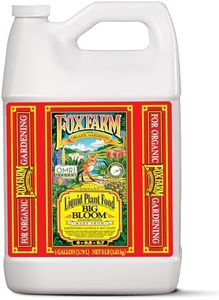
Fox Farm Big Bloom Liquid Plant Food - Organic Bloom Fertilizer for Flowering & Fruiting Plants, Contains Earthworm Castings & Bat Guano - Supports All Stages of Plant Growth - 0-0.5-0.7 NPK, 1Gallon

Rating
10.0
Chosen by1,457
Nutrient Content (N-P-K Ratio)
Source of Organic Matter
Release Rate

Most important from
13276 reviews

Nutrient Content (N-P-K Ratio)
Its low NPK ratio makes it perfect for encouraging root development, flower production, and overall plant health without risking nutrient burn.
Source of Organic Matter
The natural ingredients like bat guano and earthworm castings enrich the soil and nurture beneficial microorganisms, leading to healthier, more robust plants.
Release Rate
Using it every 7-10 days as part of a consistent feeding schedule produces vibrant blooms and lush growth across many plant types.
Application Method
Application is straightforward with clear instructions, and starting with a lower dosage helps avoid overfeeding while still delivering great results.

Fox Farm Big Bloom Liquid Plant Food is an organic fertilizer designed especially for flowering and fruiting plants. It has a low N-P-K ratio of 0-0.5-0.7, providing very little nitrogen but some phosphorus and potassium, which supports blooming and fruit development rather than leafy growth. Its main organic sources are earthworm castings and bat guano, both known for enriching soil naturally and improving plant health.

Being a liquid fertilizer, its nutrients are absorbed quickly by plants, delivering what they need without delay. This fertilizer is compatible with various soil types and gentle enough for all growth stages, making it versatile for gardeners seeking a natural boost throughout the season. Application is simple—you mix a small amount with water and apply it every other watering. It can also be used with irrigation tools, adding convenience.

One consideration is the relatively low nutrient content, so it might need to be combined with other fertilizers if plants require more nitrogen or a faster feeding schedule. It is best suited for those focusing on flowers and fruits rather than general plant feeding. Big Bloom is a reliable choice if you want an easy-to-use, organic liquid fertilizer that supports vibrant blooms and healthy fruit production.

Rating
10.0
Chosen by1,457
Nutrient Content (N-P-K Ratio)
Source of Organic Matter
Release Rate

Most important from
13276 reviews

Nutrient Content (N-P-K Ratio)
Its low NPK ratio makes it perfect for encouraging root development, flower production, and overall plant health without risking nutrient burn.
Source of Organic Matter
The natural ingredients like bat guano and earthworm castings enrich the soil and nurture beneficial microorganisms, leading to healthier, more robust plants.
Release Rate
Using it every 7-10 days as part of a consistent feeding schedule produces vibrant blooms and lush growth across many plant types.
Application Method
Application is straightforward with clear instructions, and starting with a lower dosage helps avoid overfeeding while still delivering great results.
#2

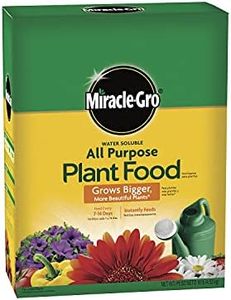
Miracle-Gro Water Soluble All Purpose Plant Food, 10 lb.

Miracle-Gro Water Soluble All Purpose Plant Food is a versatile, user-friendly fertilizer suitable for various plants, including indoor and outdoor plants, roses, flowers, houseplants, vegetables, and trees. With a significant 10 lb. container, it is designed to cover approximately 4,000 sq. ft. of garden area. This product claims to grow bigger, more beautiful plants compared to those unfed, thanks to its nutrient-rich formula that starts working instantly.

A notable strength is its easy application method; it can be used with a watering can or the Miracle-Gro Garden Feeder, making it convenient for both indoor and outdoor use. The mixing instructions are straightforward: 1/2 tsp per gallon of water for indoor plants and 1-1/2 tbsp per 1-1/2 gallon of water for outdoor plants. However, a potential drawback is that it might not be fully organic, which could be a concern for those strictly adhering to organic gardening.

Additionally, its water-soluble granules and powder form ensure quick nutrient release, which is beneficial for immediate plant needs but might require more frequent applications. It is important to consider its compatibility with your specific soil pH and the balance of nutrients it provides based on the specific needs of your garden.

#3

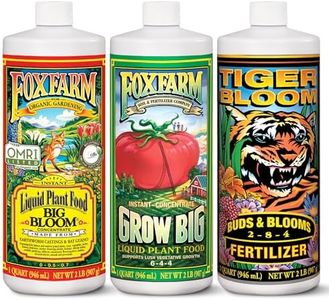
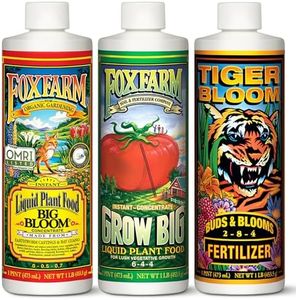
FoxFarm Soil Liquid Trio Pack - Big Bloom, Grow Big, Tiger Bloom Fertilizers Supports Vigorous Plant Growth, Bud Development & Abundant Fruit - Complete Liquid Plant Food Set - 3 Quart Bottles

The FoxFarm Soil Liquid Trio Pack offers a convenient set of three liquid fertilizers—Big Bloom, Grow Big, and Tiger Bloom—designed to provide complete nutrition for plants at various growth stages. Each formula supports different needs: Big Bloom encourages growth, Grow Big helps with vigorous development, and Tiger Bloom focuses on bud formation and fruit production. This makes the pack a good choice for gardeners growing a variety of plants, including vegetables, roses, and houseplants.

In terms of nutrient content, Tiger Bloom has a balanced N-P-K ratio of 2-8-4, suitable for encouraging flowering and fruiting. The trio’s liquid-based formulas release nutrients quickly for immediate absorption, which is helpful when fast results are desired. The low pH of Tiger Bloom helps keep micronutrients stable and accessible to plants. These fertilizers are organic-friendly, with ingredients derived from natural sources that contribute organic matter to the soil, improving soil health over time. The liquid form allows easy application by mixing the recommended teaspoons per gallon of water and applying during watering, enabling precise dosage control.

A potential downside is that liquid fertilizers generally require more frequent application compared to slow-release granular types, which might not suit every gardener’s routine. While the product works well across a range of soil types, monitoring soil pH and making adjustments as necessary is important to maintain optimal nutrient uptake. This trio pack is well-suited for gardeners seeking an effective, flexible, and straightforward feeding program for both indoor and outdoor plants.

Buying Guide for the Best Organic Fertilizers

Choosing the right organic fertilizer for your garden or farm is crucial for ensuring healthy plant growth and soil fertility. Organic fertilizers are derived from natural sources and provide essential nutrients to plants while improving soil structure and promoting beneficial microbial activity. When selecting an organic fertilizer, it's important to consider the specific needs of your plants, the condition of your soil, and the type of crops you are growing. Here are some key specifications to help you make an informed decision.
Nutrient Content (N-P-K Ratio)The N-P-K ratio represents the percentage of nitrogen (N), phosphorus (P), and potassium (K) in the fertilizer. Nitrogen promotes leafy growth, phosphorus supports root development and flowering, and potassium enhances overall plant health and disease resistance. For leafy vegetables, a higher nitrogen content is beneficial, while flowering plants and root crops may require more phosphorus and potassium. Understanding the specific nutrient needs of your plants will help you choose the right N-P-K ratio.
Source of Organic MatterOrganic fertilizers can be derived from various sources such as compost, manure, bone meal, blood meal, and seaweed. Each source has its own nutrient profile and benefits. For example, compost is excellent for improving soil structure and microbial activity, while bone meal is rich in phosphorus. Consider the specific benefits of each source and how they align with your gardening goals. If you aim to improve soil health, compost or manure might be ideal, whereas bone meal or blood meal could be better for boosting specific nutrients.
Release RateThe release rate of nutrients from organic fertilizers can vary. Some fertilizers provide a slow, steady release of nutrients over time, while others offer a quicker nutrient boost. Slow-release fertilizers, such as compost and manure, are ideal for long-term soil health and sustained plant growth. Quick-release options, like fish emulsion or liquid seaweed, are useful for addressing immediate nutrient deficiencies. Consider whether your plants need a quick nutrient boost or a steady supply over the growing season.
Soil pH CompatibilityDifferent organic fertilizers can affect the pH level of your soil. Some fertilizers, like lime, can raise soil pH, making it more alkaline, while others, like sulfur, can lower it, making the soil more acidic. It's important to test your soil's pH before choosing a fertilizer to ensure compatibility. Most plants prefer a slightly acidic to neutral pH (6.0-7.0). If your soil pH is outside this range, select a fertilizer that will help bring it closer to the optimal level for your plants.
Application MethodOrganic fertilizers come in various forms, including granular, liquid, and powder. Granular fertilizers are easy to apply and provide a slow release of nutrients. Liquid fertilizers are quickly absorbed by plants and are ideal for foliar feeding or addressing nutrient deficiencies. Powdered fertilizers can be mixed with water or applied directly to the soil. Consider the ease of application and the specific needs of your plants when choosing the form of fertilizer. For example, liquid fertilizers are great for container plants, while granular options are suitable for larger garden beds.

FAQ